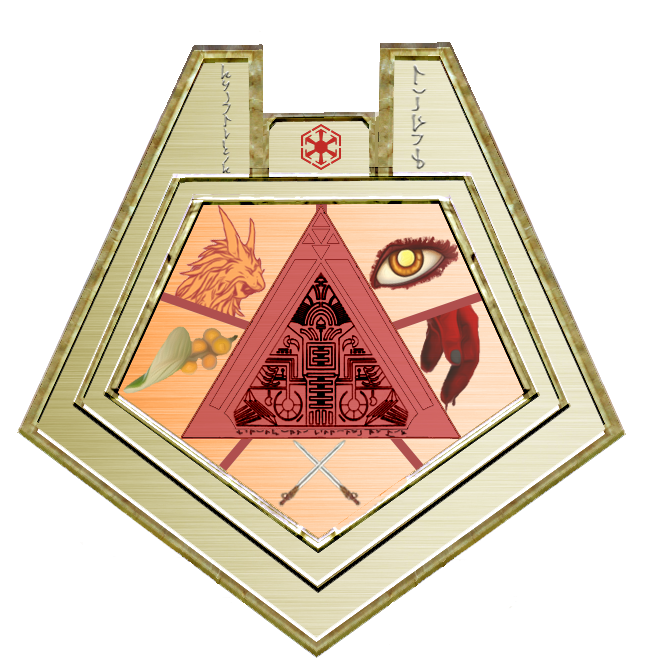
Precise bladework,
Acrobatic movement and silent navigation of architecture,
Climbing,
Pressure point knowledge,
Breath and stillness control,
Reading people,
Lying without effort,
Negotiation,
Multilingual (including rare or dead dialects),
Electronics and comm device construction from scratch,
Lock mechanisms and security system bypass,
Architectural weak point identification,
Poison making,
Toxin identification,
Toxin resistance,
Field medicine,
Forgery and identity construction,
Passive emotional sensing through the Force,
Presence suppression,
Information extraction,
Information gathering,
Orchestration of Spies and Intel agents,
Ataru (Form IV),
Niman (Form VI)

Lord Astianama
Astianama Crazire
“I find that people tell me everything eventually. Most of them think it is because they trust me. I have never corrected them.”
Created by Calvery
In-Game Name
Astianama
Species
Twi'lek
Age
31
Height
5'6
Eye Color
Purple
Hair Color
N/A
Skin Color
Red
Tattoos / Distinctions
Multiple scars across her back, she has distinctive Twi'lek black marks across her face.
Alignment
Lawful Evil
Homeworld
Nar Shaddaa
Occupation
Sith Lord / Intelligence Specialist of House Torkessh
Affiliation
Sith Empire, House Torkessh
Relationship Status
Single
Status
Active
Likes
Low light, candlelit spaces, expensive cigars, silk, leather, high vantage points, music without words, political theory, languages (dead one especially) and recreative consumption of toxins.
Dislikes
Loud individuals, wasted movements, imprecision, being asked to explain herself, second chances and slavery.
Skills
Melee Weapons
Proficient with the following weapons: Vibroblade,
Vibro-polearm,
Vibroknife,
Vibrodagger,
Electrostaff,
Ryyk blade,
Cortosis blade,
Beskar blade,
Beskad,
Combat knife,
Shiv,
Garrote,
Stun baton,
Bo-staff,
Quarterstaff,
Sith sword,
Lightsaber,
Quartersaber,
Saberstaff
Other Gear
Krezeth (Red Gizka)
Biography
Born into bondage, she entered the galaxy with nothing that could truly be called her own. No family name worth keeping, no future beyond obedience, no identity outside the will of a cruel master who treated pain as discipline and submission as destiny. For years, she endured that life in silence, learning early that survival often meant swallowing hatred and waiting for the right moment to breathe. But rage, when buried long enough, does not die. It sharpens. It festers. And in her case, it awakened something far more dangerous than rebellion.
The breaking point came in a single violent outburst. Pushed beyond fear, beyond reason, she turned on her master in a fit of incandescent fury, and in that moment the Force answered her. It did not come gently. It surged through her like a storm finally unleashed, raw and uncontrolled, tearing free from instinct rather than training. What began as an act of desperation became a massacre of restraint. For the first time in her life, she was not powerless. She was terrifying. That same power, however, drew the attention of those who understood exactly what such potential meant. She was captured soon after and sent to Korriban, not as a prisoner in chains, but as something far more valuable: an acolyte for the Sith Academy.
Korriban did not civilize her rage. It refined it. Among the tombs, the blood-soaked lessons, and the constant competition that defined academy life, she proved herself not merely capable, but exceptional. While many students chased power through bluster or cruelty alone, she adapted with ruthless precision. She learned quickly that the Sith did not reward suffering unless it could be weaponized, and she became a weapon with remarkable speed. It was there that she discovered a natural affinity for Form IV, Ataru. Where others found the style exhausting or overly aggressive, she made it look inevitable. She fought with speed, acrobatics, and savage grace, throwing herself through combat like a living blade, turning momentum into slaughter. Ataru suited her because it mirrored what she had always been beneath the chains: furious, fast, and impossible to pin down.
Her talent extended beyond combat. At the academy, she distinguished herself through discipline and instinct alike, excelling as one of the strongest in her class. The forging of her first lightsaber crystal marked a turning point in her rise. Where others sought conventional power, she produced something that set her apart: a dark blade.
Her accomplishments eventually earned her the attention of Sith Lord Ryven, who claimed her as her apprentice. Under her, her education deepened and darkened. Ryven did not train her through philosophy alone. She taught intelligence work, manipulation, covert strategy, and the value of knowing more than one’s enemies ever suspected. She showed her how to listen beneath words, how to dismantle people politically before ever needing to strike them physically, and how information could be sharper than any saber. But her lessons in power were never gentle. Ryven believed knowledge should be carved into flesh as much as mind, and much of her combat education came through brutal beatings, relentless duels, and merciless correction. She broke her down repeatedly, forcing adaptation through pain, until survival itself became a form of mastery. From her, she learned to endure, to deceive, and to kill without hesitation.
At some point in that dark apprenticeship, she was inducted into an assassin order, where her talents found a natural home. There, discipline became doctrine. Every movement, every word, every kill was governed by a strict code she was taught to respect without compromise. Assassination was not treated as simple murder, but as an art of precision, patience, and purpose. During her trial, she proved herself in a manner as cold as it was effective, killing a man with poison and completing the rite that earned her the name Pagieza. Under that name, she became a shadow given form, a hunter shaped by doctrine and sharpened by Sith brutality.
Yet even codes can become chains, and Pagieza had not survived slavery only to spend the rest of her life kneeling beneath another structure. Though she followed the assassin creed with unwavering seriousness, she eventually came to reject the order that had forged her. Whether out of disillusionment, ambition, or the simple truth that she trusted no master forever, she severed herself from it and vanished into her own path. For the last six years, she has operated alone, bound only by the principles she chose to keep and the skills that made her feared. No longer merely an apprentice, an acolyte, or an initiate, she became something far harder to control: an independent killer shaped by Sith discipline, assassin doctrine, and a lifetime of violence.
Gallery